
Key takeaways
- Schedule A goes in before the building permit is issued and each discipline's Schedule B before construction of its components starts, while Schedules C-A and C-B are filed at the end and gate occupancy.
- The structural Schedule B covers structural capacity including anchorage and seismic restraint, deep foundations, shop drawing review, unbonded post-tensioned concrete, and independent review of the structural design.
- Field review is periodic review at the professional's discretion for substantial compliance in all material respects, and it excludes construction safety, which stays with the constructor.
- Letters of assurance apply to all Part 3 buildings and only to the Part 9 components the Code names, and Vancouver uses its own versions of the forms with additional triggers under its building by-law.
In this article
- 1.What letters of assurance are, and what they are not
- 2.The four schedules at a glance
- 3.Schedule A and the coordinating registered professional
- 4.Schedule B letters of assurance: one form per discipline
- 5.What field review actually means
- 6.Schedules C-A and C-B at occupancy
- 7.Where Schedule B letters of assurance are required
- 8.The mistakes that delay occupancy
- 9.Working with MAF Engineering
Letters of assurance are the four standard forms — Schedules A, B, C-A and C-B — that a British Columbia building department uses to place responsibility for a building's design and field review on named registered professionals. Schedule A goes in before the permit is issued, each discipline's professional of record signs a Schedule B before construction of their components begins, and Schedules C-A and C-B come at the end. Without them, most authorities will not release occupancy.
Schedule A is the owner and the coordinating registered professional confirming the coordination role, filed before the permit is issued. Schedule B is one form per discipline, covering both the design and a commitment to field review. Schedules C-A and C-B are signed at completion, and most authorities want them before releasing occupancy. They apply to every Part 3 building, and to Part 9 buildings only for the components the Code names. Vancouver runs the same four schedules under its own by-law, on its own forms.
What letters of assurance are, and what they are not
A building official does not redesign your project. Where the Code requires registered professionals, responsibility for design and for reviewing construction sits with named individuals, and the schedules are how they state that to the authority having jurisdiction (AHJ). They are legal accountability documents under the administrative provisions of the BC Building Code, and Vancouver runs an equivalent set under its own by-law.
They are not construction safety documents: the forms carve out construction safety aspects, which stay with the constructor. Nor are they the only paper a building department may want. Owner's undertaking letters, insurance confirmations and municipal forms labelled Schedule D, E or F are local accountability documents, not Code letters of assurance, and several Metro Vancouver municipalities publish their own alongside the provincial set.
The four schedules at a glance
| Schedule | Official title | Who signs it | When it is due |
|---|---|---|---|
| A | Confirmation of Commitment by Owner and Coordinating Registered Professional | Owner and coordinating registered professional | Before the permit is issued |
| B | Assurance of Professional Design and Commitment for Field Review | Each professional of record, one per discipline | Before construction of the identified components; in practice, with the permit application |
| C-A | Assurance of Coordination of Professional Field Review | Coordinating registered professional | After completion, before occupancy |
| C-B | Assurance of Professional Field Review and Compliance | Everyone who signed a Schedule B | After completion, before occupancy |
Every form is signed, sealed and dated. For engineering professionals the firm's permit to practice number must be visibly applied — once per document is enough, but authorities do reject authenticated documents that lack it. Architects do not need one.
Schedule A and the coordinating registered professional
Schedule A is a two-signature form. The owner confirms they have retained a coordinating registered professional (CRP) to coordinate design work and field reviews, including the integration of functional testing of fire protection and life safety systems. The owner also commits to notifying the AHJ immediately if that CRP stops acting — even if the firm does not change — and to halting work until a replacement is retained and a new Schedule A submitted.
The CRP is the single point of coordination between disciplines, not the designer of everything:
- determining which registered professionals of record the project needs, so no scope falls between two Schedule B letters;
- coordinating the disciplines' work through design, construction and occupancy;
- initialling each Schedule B and Schedule C-B, which shows the AHJ the set is complete; and
- collecting the Schedule C-B letters and signing the Schedule C-A.
On most buildings the architect is the CRP; where there is no architect, a structural engineer may take it if the scope suits. BCBC 2024 was amended during 2024 to refine the definition, so work from the current forms. Some authorities do not insist on a CRP where there is a single professional of record. Confirm it locally.
Schedule B letters of assurance: one form per discipline
Schedule B is the form people mean when they ask for "a Schedule B from the engineer". It offers eight boxes to initial: architectural, structural, mechanical, plumbing, fire suppression systems, electrical, geotechnical — temporary, and geotechnical — permanent. Each professional initials their own and crosses out items that do not apply. All go in with the permit application, with detailed fire suppression design the recognised exception.
Note what is missing: there is no building envelope box. Envelope items — roofing and flashings, wall cladding, condensation control, exterior glazing, environmental separation — sit under the architectural discipline. An envelope specialist normally acts as a supporting registered professional assisting the architect, using the separate S-B and S-C commitment forms rather than a Code letter of assurance.
What the structural Schedule B commits you to
The items a structural engineering consultant initials are short and specific: the structural capacity of the building's structural components including anchorage and seismic restraint; the structural aspects of deep foundations; review of all applicable shop drawings; the structural aspects of unbonded post-tensioned concrete; and independent review of the structural design.
That last item is the one to read twice. Engineers and Geoscientists BC requires a documented independent review of structural designs, carried out by a qualified professional who was not involved in preparing the design, and the record can be asked for. Arrange the review before the line is initialled, not after.
The deep foundations line earns attention across much of Metro Vancouver. On the Fraser River delta — Richmond, Delta, south Surrey and parts of south Vancouver — soft, potentially liquefiable silts and sands often push a building onto piles, which is where foundation design and the geotechnical professional's permanent-works schedule have to line up.
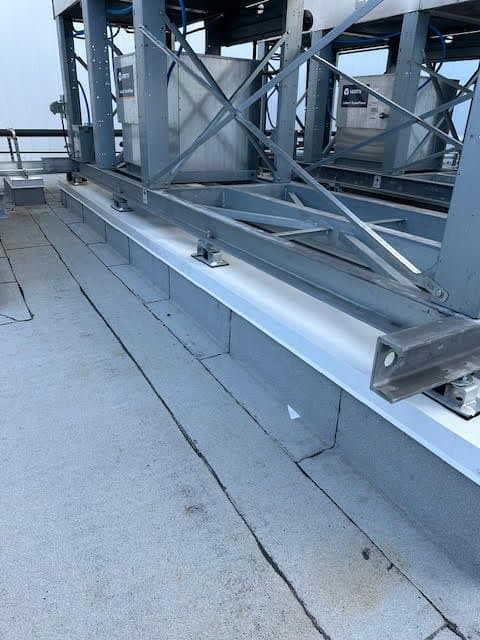
Anchorage and seismic restraint are allocated by discipline rather than left to argument: the architectural, structural, mechanical and electrical pages each carry a line for the structural capacity, anchorage and seismic restraint of that discipline's own components. What varies is who does the engineering. Restraint of mechanical and electrical equipment is commonly designed by a supporting registered professional, with CSA S832 the usual Canadian reference, while the discipline's professional of record keeps the Schedule B item. Settle who is doing that seismic engineering work before the permit issues.
What field review actually means
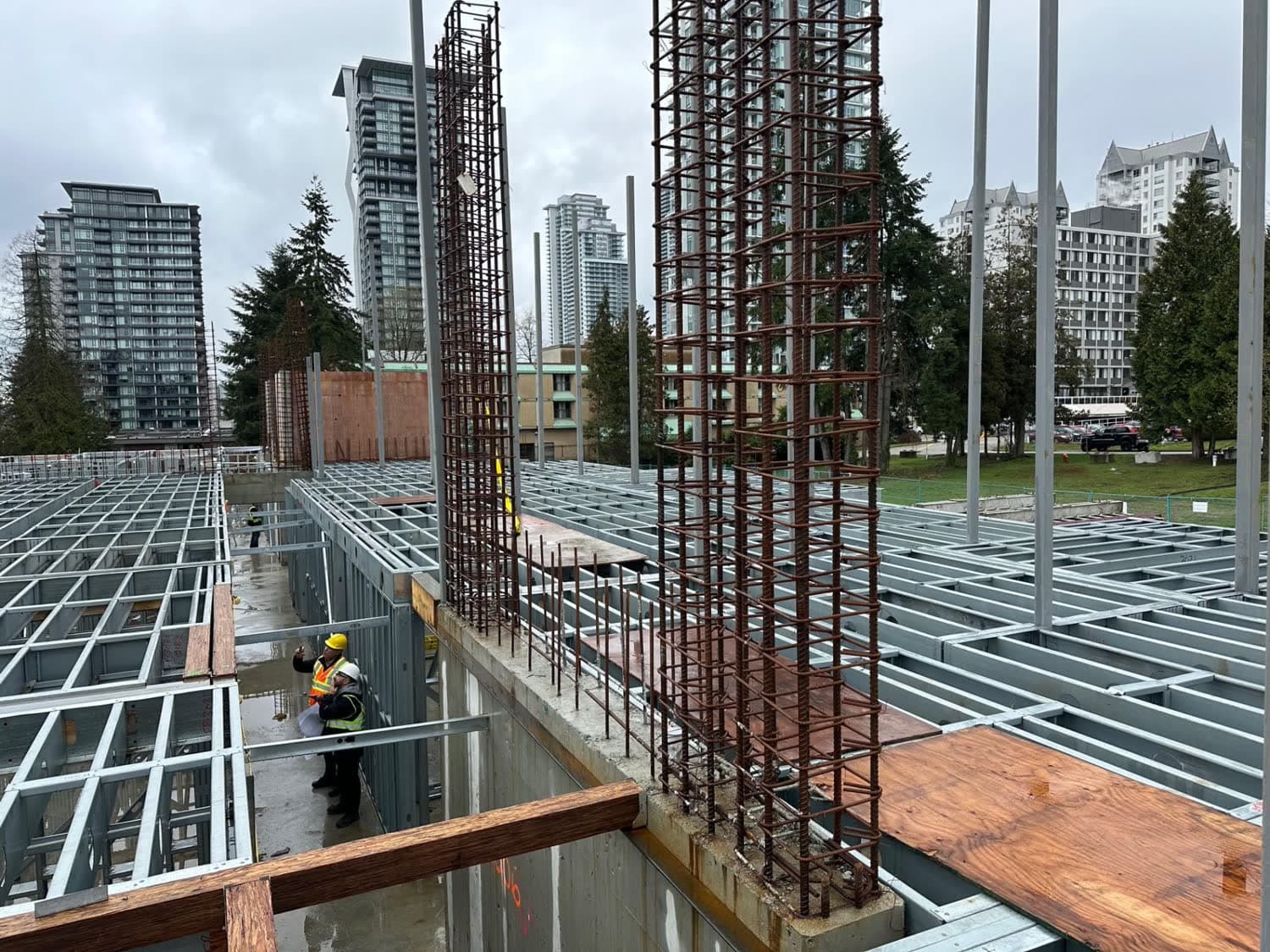
The Code defines field review as a review of the work at the building site and, where applicable, where components are fabricated for use at the site, that the registered professional in their professional discretion considers necessary to ascertain whether the work substantially complies in all material respects with the plans and supporting documents.
Four phrases carry the meaning:
- Professional discretion. Frequency is the professional's call, set from the risk and complexity of the work. Field review is periodic by design — not full-time inspection, not supervision.
- Substantially complies in all material respects. The engineer confirms the work matches the design intent, not that every bolt was witnessed.
- At fabrication locations, where applicable. Shop review of fabricated steel or precast is part of the commitment.
- Except for construction safety aspects. Formwork, shoring and site safety stay with the constructor. Temporary excavation support has its own geotechnical — temporary box.
A signed schedule is not a warranty, and municipal inspections continue in parallel. Field reviews should generate dated written reports, and those reports are what a Schedule C-B rests on. The contractor also has to give notice before work is covered: a shear wall closed in before the nailing was seen means opening it up again. That matters most on tenant improvement work, where conditions appear only during demolition.
Schedules C-A and C-B at occupancy
At completion each professional who signed a Schedule B signs a matching Schedule C-B, and the CRP collects them, confirms coordination and signs the Schedule C-A. Both reach the AHJ after completion but before an occupancy permit is issued or a final inspection made. Municipalities generally expect the C-A and C-B set to match the Schedule B set filed at permit, and municipalities such as Burnaby say as much in their occupancy guidance.
Most authorities will not release occupancy until the C-A and every required C-B is in hand. The usual reasons one is missing:
- The work was never reviewed, so exposure, testing or analysis is needed first.
- Deficiencies remain open inside a professional's scope and need correcting and re-reviewing.
- A supporting design was never closed out, leaving specialty documents and S-C confirmations outstanding.
- The engagement lapsed. Because the schedules are sealed by individuals rather than firms, a departed professional cannot sign; an incoming professional of record files a new Schedule B and needs evidence to stand behind work they did not design.
Where Schedule B letters of assurance are required
Letters of assurance apply to all Part 3 buildings: most multi-family, commercial, institutional and industrial work.
For Part 9 housing and small buildings they are, in the provincial guidance's own words, generally not intended to apply, although authorities having jurisdiction often elect to use them. What the Code requires is narrower: Part 9 buildings with common egress systems requiring firewalls, and, in other Part 9 buildings, structural components and geotechnical conditions outside the scope of Part 9, plus sprinkler and standpipe systems designed to the NFPA standards. Beams carrying point loads, girder trusses, long-span trusses and proprietary engineered products are the examples given. Where a Part 9 building has numerous engineered components, many authorities ask that the letter cover the integrated structural design and field review for the whole building — a common outcome on multiplexes built under BC's small-scale multi-unit housing reforms; see structural engineering for SSMUH multiplexes, or when a structural engineer is required in BC if you are unsure your project crosses the line.
Vancouver runs the same four schedules under the Vancouver Building By-law 2025, in force from September 2025 with transition provisions for in-stream projects — see what changed in the Vancouver Building By-law 2025. Two differences matter: the City issues its own versions of the forms, so use those rather than the provincial set; and the by-law names many additional circumstances requiring registered professionals, including on Part 9 buildings. A house needing no letters of assurance in a neighbouring municipality may need them in Vancouver.
Several BC municipalities also run Certified Professional programs, an alternative permit stream that still requires the same letters. Confirm the document list at application rather than assuming a neighbour's checklist transfers.
The mistakes that delay occupancy
Between permit and occupancy, changes get documented as revisions, and a significant one may need a revised submission and a revised Schedule B.
The costly mistakes are predictable: treating Schedule B as a permit formality rather than a commitment that has to be scoped and resourced; leaving a scope uncovered, because if nobody's Schedule B claims it, nobody's C-B will either; assuming the envelope or the seismic restraint of equipment is somebody else's box; initialling the independent review line without having arranged the review; and waiting until the occupancy inspection to start collecting C-B letters.
Working with MAF Engineering
MAF Engineering signs Schedule B and Schedule C-B as the structural professional of record on Part 3 and Part 9 projects across Greater Vancouver, the Fraser Valley, Sea-to-Sky and Vancouver Island, and takes the coordinating registered professional role where the scope suits. Principal Mir Afshar Niakouei, P.Eng. is registered in British Columbia, Alberta and Ontario and belongs to EGBC and SEABC.
If you are scoping a permit submission, or closing out a C-B on a finished job, call 778.840.9867 or get in touch. We will confirm which schedules your authority expects, which structural items belong on your Schedule B, and the field review needed to close them.
Frequently asked questions
Can the same engineer sign both the Schedule B and the Schedule C-B?
Normally yes, and normally it must be the same individual. Letters of assurance are sealed by a named professional rather than by a firm, so the C-B confirms that the field reviews promised on that person's Schedule B were carried out. If the professional changes during construction, the authority having jurisdiction must be notified and the incoming professional files a new Schedule B.
Does a structural Schedule B cover shop drawings sealed by a specialty engineer?
The structural Schedule B includes review of all applicable shop drawings, but that is a review for conformance with the design intent. Specialty designs such as steel connections, precast elements or cold-formed steel panels are usually prepared by a supporting registered professional who seals their own documents and issues S-B and S-C commitments. Agree the split before the permit issues.
Is there a separate Schedule B for building envelope in British Columbia?
No. The Code Schedule B lists architectural, structural, mechanical, plumbing, fire suppression, electrical and geotechnical disciplines, and envelope items sit within the architectural discipline. Envelope specialists providing enhanced services normally act as supporting registered professionals to the architect using the S-B and S-C forms. Some authorities ask for extra local documentation, so confirm at application.
How often will the engineer visit site during field review?
There is no fixed number. The Code leaves frequency to the professional's discretion, proportionate to the risk, complexity and stage of the work, and visits concentrate where it matters most: foundations, reinforcement before concrete, framing and lateral connections. Fabrication shops may also be reviewed. Field review is periodic by design, not continuous inspection of every operation.
What happens if the engineer refuses to sign the Schedule C-B?
A professional cannot sign for work they did not review or that does not substantially comply with their design. The path forward is to identify the specific gap, then expose, test, analyse or correct as required until the professional can honestly sign. Pressing for a signature is not a route; resolving the underlying deficiency is the only one.
More answers on our frequently asked questions page.
Mir Afshar Niakouei, P.Eng.
Principal of MAF Engineering Ltd., a consulting structural, seismic and civil engineering practice serving Greater Vancouver, British Columbia. Registered as a Professional Engineer in British Columbia, Alberta and Ontario, with more than 25 years designing hospitals, hotels, institutional, industrial and residential structures.